Aluminum Mini Blinds for Greenwood, IN
Shallow depth aluminum for Greenwood utility rooms and rental turns
What follows covers the practical side of this service: how it's measured, what changes the price, how long fabrication takes and what maintenance it needs once it's hanging.
- Service: Aluminum Mini Blinds for Greenwood homeowners
- Service area: Greenwood, IN and surrounding areas How soon depends on which job it is. A new custom order waits on fabrication, typically two to five weeks after the measure. A repair like a restring or a cord lock doesn't wait on anything.
- Insured and bonded
- Serving Greenwood, IN since 2008
Expert Aluminum Mini Blinds for Greenwood Homes
Greenwood has a bigger use case for aluminum than most suburbs its size, and the reason is tenure. Only 59.3 percent of homes here are owner occupied, and 10,753 of the 26,415 occupied units are rentals, concentrated along the US 31 and County Line Road corridors. A 1 inch aluminum blind is the covering that gets specified when a unit turns over, because it's cheap to replace, it survives a move out, and it doesn't hold odor. Owners use it too, in the places nobody photographs: a laundry room off a Carefree hallway, a basement stair window, the garage entry in a 1970s split level.
The failure is permanent and cosmetic. Aluminum slats crease when someone bends one to look outside, and a creased slat never comes back. Cheap gauge is where that happens, so we specify a heavier slat and tell you the price difference rather than quietly saving you eleven dollars. The other disclosure is light: the route holes that carry the lift cords let daylight through even when the blind is closed tight, which makes aluminum a poor choice in a bedroom used by anyone sleeping past sunrise. For an east facing bedroom on one of Brentwood's tree named streets, a cellular shade or a room darkening roller is the correct call, and we'll say so before you fit aluminum through a whole house.
Signs You Need Aluminum Mini Blinds
If you notice any of these in your Greenwood home, it is worth booking a measure. None of it is urgent, and none of it fixes itself either.
Tenants keep bending the same slats out of shape
A looped cord hangs beside a crib
You need one unit reordered without another measure visit
A small office needs matching blinds throughout
A workshop window has had nothing on it for years
Narrow glass beside the front door has nothing on it
The bottom rail has rusted in a damp basement
A metal stud wall pulled the old brackets right out
Sidelight glass is too shallow for a wide slat
Slats are creased where a pet pushed through them
How Greenwood Window Treatments Handles Aluminum Mini Blinds
Every job follows the same five-step process. Transparent, thorough, and done right the first time.
Three widths per opening
Slat size and gauge chosen
Brackets set to the substrate
Anchor type matched to substrate
Old blinds and brackets removed
Aluminum Mini Blinds in Greenwood
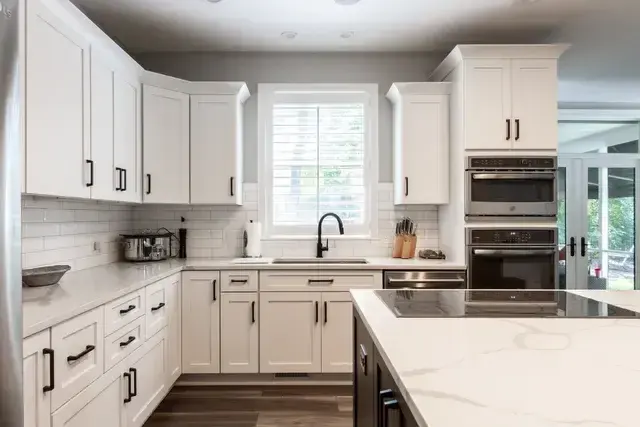
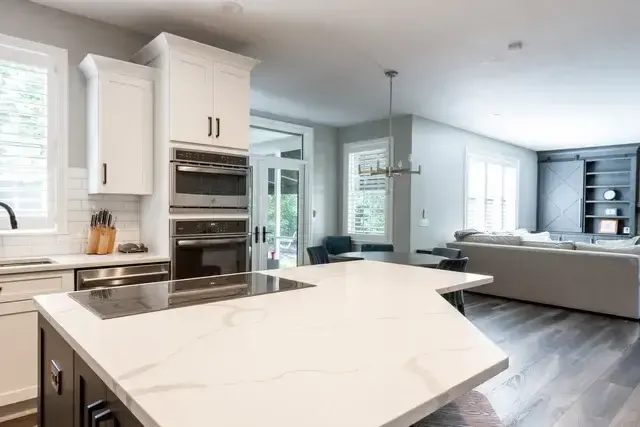
Photographs from real aluminum mini blinds jobs completed by our crew in Greenwood and surrounding areas.
What Aluminum Mini Blinds Includes
Every Greenwood job is documented item by item. Here is what the crew covers.
Every opening measured on its own and cut to size at the factory, never trimmed down from a stock blind on a truck
Three widths taken per opening so the narrowest one governs the order, because a mini blind binds fast if it's cut long
Corner-to-corner square check on every opening, including the utility ones nobody looks at twice
Slat gauge specified, the heavier gauge where a blind gets handled daily and the lighter one where cost governs
Slat size set per opening, 1 inch as the standard, 1/2 inch on shallow openings and sidelights, 2 inch where a wider face suits
Mounting depth read so a 1 inch headrail clears any handle, lock or crank inside the opening
Inside or outside mount decided opening by opening rather than once for a whole building
Cordless lift specified in units children use and offered as the default on rental turnovers
Products specified to conform to ANSI/WCMA A100.1-2022 for cord access
Cord tilt or wand tilt chosen against what the room actually needs rather than what's cheapest
Bracket substrate identified before install day: drywall, plaster, hardwood trim, block or steel
Color matched across a run so a whole building reads the same from the parking lot
Unit counts and finished sizes listed per opening on the paperwork so a single blind can be reordered later
Valance clips counted and checked, since a snapped clip is the usual reason a valance sits crooked
Light gap per side disclosed even on the least expensive units in the order
Old blinds removed, brackets pulled and the hardware hauled off rather than left in a bag
Every blind tilted through full travel and raised to the headrail before sign-off
Exact color and slat size written down for the owner where a building is getting a run of them
What Aluminum Mini Blinds Cost in Greenwood
National figures for the category put stock blinds and shades around $60 to $600 a window, with custom-fabricated product running roughly $250 to $2,600. Aluminum sits at the bottom of that, and there's no reason to pretend otherwise. It's the least expensive thing we hang, and on a rental turnover or a run of utility openings that's exactly the point. What you're paying for over a box-store blind is that each unit gets cut to your measured opening rather than trimmed down from a stock width, plus a heavier slat gauge if you want one. Volume changes the math on a building in Johnson County. Greenwood Window Treatments prices per opening in Greenwood rather than by the box.
How Aluminum Mini Blinds Differ by Product
Every product in this trade behaves differently in a room. Here is what that means for this work.
1 inch aluminum slat: The standard mini blind and the reason the category exists. A thin slat stacks to almost nothing at the top, fits shallow openings other products can't, and costs less than anything else that still counts as a real window covering.
1/2 inch micro slat: Half the slat width, so the stack is tiny and the blind almost disappears when raised. It's the answer on a shallow opening, a narrow sidelight beside a door, or a small commercial opening where a 1 inch headrail won't clear.
2 inch aluminum slat: A wider aluminum slat that reads more like a blind and less like a utility fitting. It gives better view when tilted open and covers more per slat. Choose it where the budget is tight but the room is still one people sit in.
Heavier gauge slat: Thicker aluminum that resists a crease and springs back from a knock that would permanently fold a thin slat. It costs a little more per unit. On any opening people reach through daily, that difference pays back within the first year.
Lighter gauge slat: The thinner, less expensive slat. It's honest value on openings that get looked at rather than handled, like a high utility window or a stairwell landing, and it's the wrong pick anywhere a hand is going in every day.
Cord tilt: A short cord loop beside the headrail that turns the tilt. It's the traditional control, it costs nothing extra, and it's the one to avoid where a child could reach it or a door swing keeps catching the loop.
Wand tilt: A rigid wand instead of a hanging tilt cord. Nothing loops, nothing swings into a door, and it's what we specify on any unit where a cord shouldn't be present at all. On mini blinds it adds very little to the price.
Cordless lift: No lift cord on the blind, with a spring mechanism doing the work in the headrail. On a light aluminum blind cordless feels particularly good, and it's the specification we push on rentals where you can't control who lives there next.
Perforated slats: Slats punched with a fine pattern so some daylight passes even when the blind is closed. It's a light-and-privacy compromise you occasionally want in a commercial corridor or a stairwell, where full darkness is the wrong outcome.
Hold-down brackets: Small brackets at the bottom rail that pin the blind to the frame. They stop a blind swinging every time a door opens, which is why they belong on any opening set into a door and on windows near a busy walkway.
Aluminum Mini Blinds FAQ
Questions we hear most often from Greenwood homeowners considering aluminum mini blinds.
Aluminum Mini Blinds Across Greenwood
We measure and install in every one of these Greenwood neighborhoods. Each has its own page with the build eras, window conditions and mounting notes for that section.
- Aluminum Mini Blinds in Greenwood Residential Historic District
- Aluminum Mini Blinds in Carefree
- Aluminum Mini Blinds in Eagle Trace
- Aluminum Mini Blinds in Willow Lakes
- Aluminum Mini Blinds in Sheffield Park
- Aluminum Mini Blinds in Foxberry Trace
- Aluminum Mini Blinds in Innisbrooke
- Aluminum Mini Blinds in Brentwood
- Aluminum Mini Blinds in Fairview Heights
- Aluminum Mini Blinds in Woodland Streams
- Aluminum Mini Blinds in Hickory Stick
Other Window Treatment Services in Greenwood
Greenwood Window Treatments handles the full scope of window treatment work. Explore our other services below.
Faux Wood Blinds in Greenwood
Moisture proof slats where Greenwood kitchens and baths punish real wood
Learn more →Wood Blinds in Greenwood
Stained basswood for Greenwood's stain grade trim, honestly specified
Learn more →Vertical Blinds in Greenwood
Vane systems for the sliders on nearly every Greenwood rear elevation
Learn more →Schedule Your Free In-Home Measure in Greenwood
Reach Us Directly
Our team prioritizes scheduled measures and service calls, and books in-home measures during business hours.
Ready to Book Your Measure?
Call us to set up an in-home measure, or to ask about a treatment that has stopped working. We will talk it through on the phone first.