Faux Wood Blinds for Greenwood, IN
Moisture proof slats where Greenwood kitchens and baths punish real wood
This section covers what the product does well, where it struggles, and what it costs to own over time rather than just to buy. All three matter on a purchase you'll live with for years.
- Service: Faux Wood Blinds for Greenwood homeowners
- Service area: Greenwood, IN and surrounding areas How soon depends on which job it is. A new custom order waits on fabrication, typically two to five weeks after the measure. A repair like a restring or a cord lock doesn't wait on anything.
- Insured and bonded
- Serving Greenwood, IN since 2008
Expert Faux Wood Blinds for Greenwood Homes
Greenwood put up 3,024 houses in the 1970s alone, the biggest decade inside a 1940 to 1979 band that still holds 6,944 units, and that stock is where faux wood does its best work. Those plans cluster a bath, a utility room, a kitchen window and a back entry within a few steps of each other, all of them small openings sitting in air that carries moisture. PVC and composite slats hold a straight line through it. Carefree is the plainest example, 704 parcels on streets named Nevermind Way and Primrose Path, where 10 to 16 openings cover a whole ranch and several of them sit in rooms real wood would resent.
The material has one real weakness and it turns up on wide openings. PVC weighs more than basswood, so a single blind carried across a picture window sags at the middle over the years, and heat on a south wall speeds that along. The 1970s living room picture window is precisely that opening. Our answer is two blinds under one continuous valance, or a composite slat with an intermediate bracket taking the weight at the middle. The second limit is finish. Nothing in this category accepts stain, so against the walnut toned casing common in that era we're matching a paint color to stained wood, which is a near miss.
Signs You Need Faux Wood Blinds
If you notice any of these in your Greenwood home, it is worth booking a measure. None of it is urgent, and none of it fixes itself either.
Wood blinds over the tub have started to cup
Laundry room slats have gone wavy along one edge
The blind above the kitchen sink looks swollen
You want the look of wood in a wet room
You are buying blinds for a house you plan to sell
Route holes glow in a line once the blind closes
The valance is missing and the headrail shows from the couch
A rental turnover needs blinds that survive tenants
You added a window and the old white no longer matches
Tilting the slats takes two hands and real patience
How Greenwood Window Treatments Handles Faux Wood Blinds
Every job follows the same five-step process. Transparent, thorough, and done right the first time.
Mounting depth taken
Slat size and color set
Light gap disclosed in writing
Installed, tilted and travel tested
Valance style picked with returns
Faux Wood Blinds in Greenwood
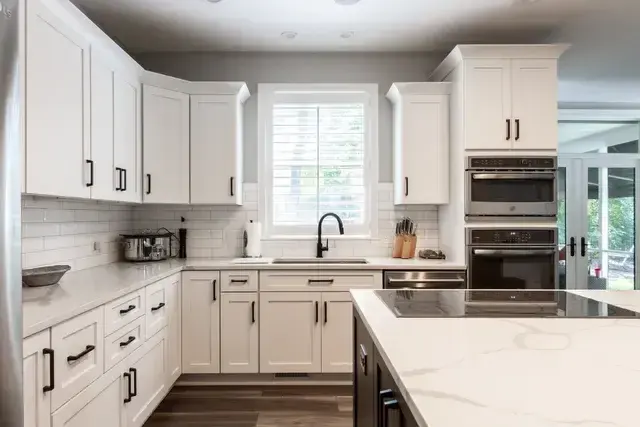
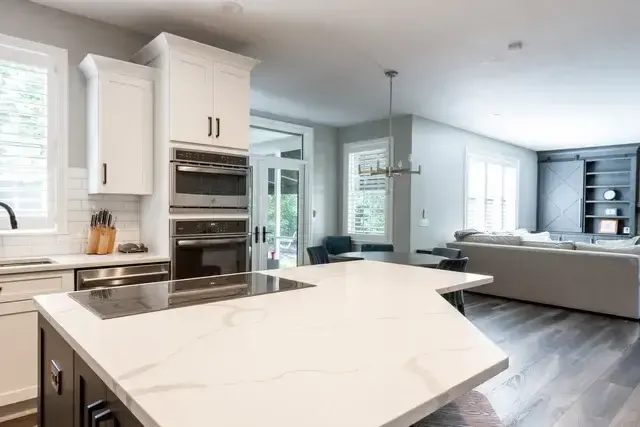
Photographs from real faux wood blinds jobs completed by our crew in Greenwood and surrounding areas.
What Faux Wood Blinds Includes
Every Greenwood job is documented item by item. Here is what the crew covers.
Every opening measured three widths and three heights, then checked corner to corner for square
Room moisture read before the material call, so baths, kitchens, laundry rooms and finished basements get faux wood
Mounting depth taken at the top of the opening so a 2 inch headrail clears the trim and any hardware
Solid PVC and wood-polymer composite separated on the order, because they don't weigh the same or behave the same
West and south openings flagged, since surface heat on a dark slat is what starts a bow
Slat size set per opening, 2 inch as the standard and 2 1/2 inch where the window is wide enough to carry it
Center support bracket planned on any span wide enough to let a loaded headrail settle in the middle
Wide openings split two-on-one so no single blind carries more weight than its brackets should
Finished weight checked against the opening before a wide unit gets ordered as one piece
Routeless slats specified where a row of lit route holes would be noticed from inside the room
Cloth tape ladders offered where the route holes should disappear behind a band of fabric
Tilt wand set as the default, with cord tilt only where a wand can't clear a handle or a return
Cordless lift specified in rooms that kids and pets actually use
Products specified to conform to ANSI/WCMA A100.1-2022 for cord access
Valance style and return depth chosen so an outside mount really closes off the sides
Factory deduction left with the manufacturer so the allowance never gets taken twice
Light gap per side written onto the paperwork before the order goes to the factory
Old blinds pulled, brackets removed, and every new unit tilted and lifted end to end before we leave
What Faux Wood Blinds Cost in Greenwood
National category figures put stock blinds and shades near $60 to $600 a window, with custom-fabricated units running roughly $250 to $2,600. Those are published national ranges for the category, not a quote for any address in Greenwood. Faux wood lands low in that band, which is most of why people choose it. A 2 inch composite blind on an ordinary bathroom opening is inexpensive work. Price climbs when the opening gets wide, because weight is the real constraint here: a wide span wants a center support bracket or a two-on-one headrail, and both add parts and install time. Routeless slats, cloth tapes and a cordless lift each move the number as well. Greenwood Window Treatments prices from measured openings around Johnson County, never from a per-window average.
How Faux Wood Blinds Differ by Product
Every product in this trade behaves differently in a room. Here is what that means for this work.
2 inch faux wood slat: The size most houses around here want, and the one we start from. It gives you a real view between open slats without the stack a wider slat builds at the top, and it stays flat across an ordinary bath or bedroom opening.
2 1/2 inch faux wood slat: Fewer slats over the same height, so the face reads cleaner and the open view improves. It also weighs more per running foot, which is exactly why we settle the span and the bracket plan before writing it onto a wide window.
Solid PVC slats: The least expensive construction we hang and the most waterproof. It's also the heaviest, and it's the one most willing to take a bow on hot glass, so we keep it to smaller openings and off the west wall in July.
Wood-polymer composite slats: Wood flour blended with polymer, stiffer and lighter than solid PVC at the same slat size. It costs a bit more and it holds a straight line better on a wide opening or a sunny one, so it's what we specify by default.
Routeless slats: The lift cord runs through a notch at the back edge instead of a hole punched through the face. With the blind closed there's no row of pinholes glowing at you across a dark bedroom. It costs more and it earns it there.
Cloth tape ladders: A woven tape that hides the route holes and lays a color band down the face of the blind. It changes the look more than anything else on the order, and it narrows the view slightly wherever a tape crosses a slat.
Cordless lift: A constant-force spring inside the headrail in place of a lift cord. It's what goes into rooms children use. On a heavy faux wood unit it wants a hand near each end of the bottom rail rather than one hand in the middle.
Tilt wand: A clear or color-matched wand that turns the tilt mechanism. Nothing hangs loose off the headrail, it clears a door handle better than a cord loop does, and it's the default we begin from on almost every faux wood job.
Center support bracket: An extra bracket carried under the middle of a long headrail. On a wide faux wood blind that bracket isn't decoration, it's what keeps the rail from taking a set and the slats from dragging harder on one side than the other.
Two-on-one headrail: Two blinds sharing a single continuous headrail across a wide opening, each with its own lift and tilt. It keeps each unit at a weight the brackets and your arm can manage, and the split position gets written on the order so nobody guesses.
Faux Wood Blinds FAQ
Questions we hear most often from Greenwood homeowners considering faux wood blinds.
Faux Wood Blinds Across Greenwood
We measure and install in every one of these Greenwood neighborhoods. Each has its own page with the build eras, window conditions and mounting notes for that section.
- Faux Wood Blinds in Greenwood Residential Historic District
- Faux Wood Blinds in Carefree
- Faux Wood Blinds in Eagle Trace
- Faux Wood Blinds in Willow Lakes
- Faux Wood Blinds in Sheffield Park
- Faux Wood Blinds in Foxberry Trace
- Faux Wood Blinds in Innisbrooke
- Faux Wood Blinds in Brentwood
- Faux Wood Blinds in Fairview Heights
- Faux Wood Blinds in Woodland Streams
- Faux Wood Blinds in Hickory Stick
Other Window Treatment Services in Greenwood
Greenwood Window Treatments handles the full scope of window treatment work. Explore our other services below.
Wood Blinds in Greenwood
Stained basswood for Greenwood's stain grade trim, honestly specified
Learn more →Vertical Blinds in Greenwood
Vane systems for the sliders on nearly every Greenwood rear elevation
Learn more →Aluminum Mini Blinds in Greenwood
Shallow depth aluminum for Greenwood utility rooms and rental turns
Learn more →Schedule Your Free In-Home Measure in Greenwood
Reach Us Directly
Our team prioritizes scheduled measures and service calls, and books in-home measures during business hours.
Ready to Book Your Measure?
Call us to set up an in-home measure, or to ask about a treatment that has stopped working. We will talk it through on the phone first.