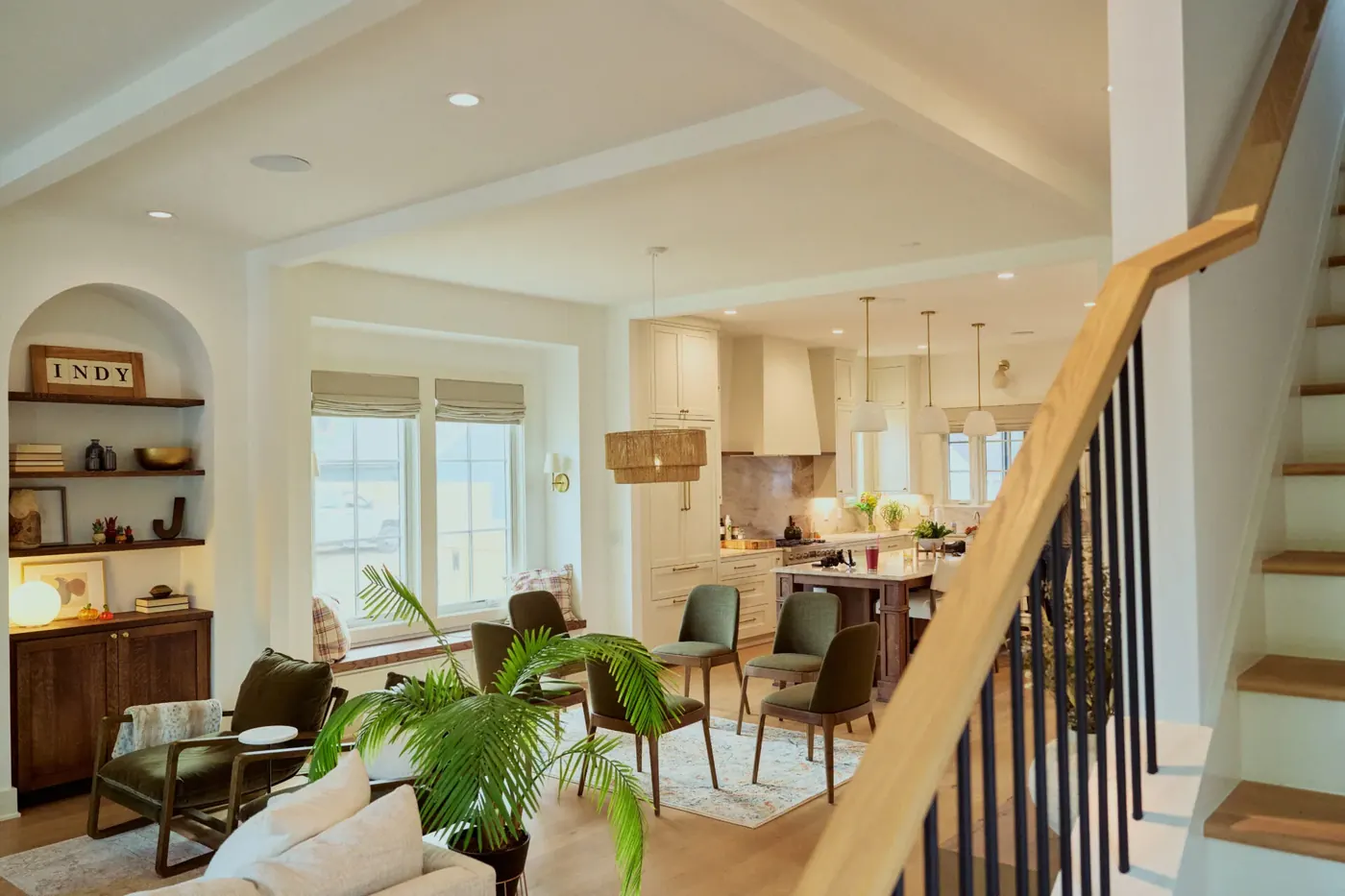
Roman Shades in and Around Greenwood, IN
Soft folds for Old Town proportions and Greenwood dining bays
If you've narrowed things down to this product, these answers should confirm the choice or steer you elsewhere. Either outcome is fine. Ordering the wrong thing in custom sizes is the expensive mistake.
- Service: Roman Shades for Greenwood homeowners
- Service area: Greenwood, IN and surrounding areas Getting somebody out to measure is the easy part and happens on a normal schedule. After that the fabricator needs roughly two to five weeks. We give you a specific window when we write the order.
- Insured and bonded
- Serving Greenwood, IN since 2008
Expert Roman Shades for Greenwood Homes
Roman shades put fabric in the window without a rod, which is why they belong in Greenwood's oldest and its most formal rooms. The Greenwood Residential Historic District carries about 300 buildings from the 1870s onward, and its openings are tall and narrow, frequently arched, and built to a height to width ratio nothing in the modern stock matches. Fabric handles that proportion where a slatted product looks wrong. The other natural home is the dining room and study in the 1990s stock, where 5,460 houses were built in that decade and the trim is stain grade, and in the 1980s bay windows that show up in dining rooms across Brentwood and Sheffield Park.
Stack height is the cost. A raised Roman shade folds into a stack at the head that can run six to twelve inches deep depending on fabric weight and fold style, and that stack sits over the top of your glass permanently. On the tall Old Town openings that's tolerable. On a standard 1990s bedroom window it takes a real bite out of the view. Fabric also relaxes and hems can go slightly out of level over years. A flat fold shows every wrinkle, a hobbled fold hides them and uses more yardage. If you're adding a matching shade next year, order the fabric now: dye lots move.
Signs You Need Roman Shades
If you notice any of these in your Greenwood home, it is worth booking a measure. None of it is urgent, and none of it fixes itself either.
A raised shade covers the top of the glass
Two windows in one room no longer match
A wide fabric shade dips along its bottom edge
Rings and tapes print through in afternoon sun
Cloth over the cooktop has gone dark and greasy
One shade hangs lower on the left side
Ready-made panels never fit the opening properly
The room echoes off hard floors and bare windows
Panels pile on the floor and collect dust
Folds hang crooked with creases from shipping
How Greenwood Window Treatments Handles Roman Shades
Every job follows the same five-step process. Transparent, thorough, and done right the first time.
In-home measure and fabric review
Mounting depth read at top
Pattern repeat and yardage figured
Board mounted into real structure
Ring spacing set to width
Roman Shades in Greenwood
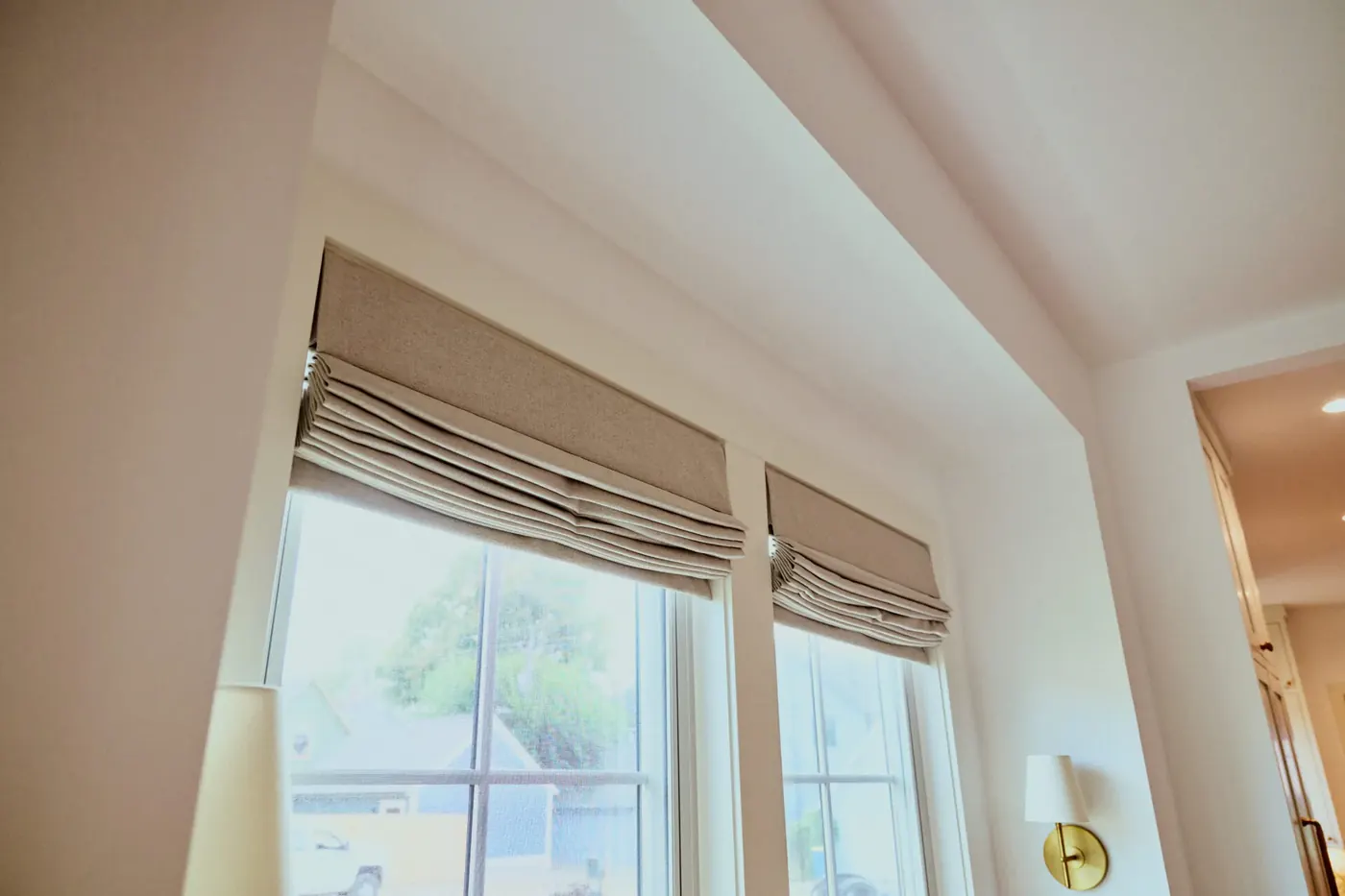
Photographs from real roman shades jobs completed by our crew in Greenwood and surrounding areas.
What Roman Shades Includes
Every Greenwood job is documented item by item. Here is what the crew covers.
Three widths and three heights taken at every opening, then a diagonal check so the shade hangs level
Mounting depth read at the top of the opening to see whether the stacked folds clear the trim on an inside mount
Stack height calculated from finished height, fold count and lining, then shown to you before anything is ordered
Outside mount height set above the opening wherever the stack would otherwise sit across the glass
Fold style specified room by room: flat, relaxed, hobbled or London
Fold count and fold depth written on the order so the bottom fold doesn't come up short
Lining specified per elevation, light filtering or room darkening or none, and stated in writing
Interlining added where the face fabric needs body or where the room wants weight and quiet
Pattern repeat measured so the motif lands at the same height on every shade in a room
Fabric run direction decided against the width, since a wide shade may need the goods turned
Ring rows and dowel pockets drawn to the fold spacing instead of a factory default
Lift chosen as cordless, a continuous cord loop with a tensioner, or a motor
Cord safety handled to ANSI/WCMA A100.1-2022, with cordless specified anywhere a child can reach
Mounting board wrapped in the face fabric where the board itself will show from the room
Return depth dimensioned on outside mounts so the sides close off against the wall
Brackets fastened into framing or into anchors rated for a lined shade's weight, not into bare drywall
Shades steamed on site so the creases from folding and shipping fall out of the cloth
Folds dressed by hand and the shade cycled a few times so every fold trains and breaks in the same place
What Roman Shades Cost in Greenwood
National category figures put stock shades at roughly $60 to $600 per window and custom-fabricated shades at roughly $250 to $2,600 per window. Those are national ranges published for a category, not a price for any address in Greenwood, and Greenwood Window Treatments quotes from a measure rather than an average. Romans usually sit in the upper part of that band, because what you're buying is yardage and sewing rather than cloth wrapped on a tube. Fabric moves the number first and it's sold by the yard, so a large pattern repeat adds cloth before anyone cuts. Lining and interlining come next. Then fold style, since a hobbled shade eats noticeably more fabric than a flat one of the same size. Two Johnson County windows of identical size can land far apart on cloth alone.
How Roman Shades Differ by Product
Every product in this trade behaves differently in a room. Here is what that means for this work.
Flat Roman: One uninterrupted face of fabric when the shade is down, with folds appearing only as it rises. It shows a print or a weave better than any other style, and it's the one we specify in rooms that want a quiet, tailored line.
Relaxed Roman: Built without a dowel in the bottom fold, so the hem carries a soft curve instead of a straight line. It suits a kitchen window over a sink or a casual room, and it forgives a slightly unlevel opening better than a flat shade does.
Hobbled Roman: Permanent cascading folds stay stacked down the whole face whether the shade is up or down. It reads soft and traditional, it uses considerably more yardage, and it stacks much taller when raised. Plan the mount height around that.
London shade: Gathered at two points with soft tails falling at each side, usually hung as a stationary treatment or one that gets raised rarely. It's a decorative shade for a powder room, a stair landing or a window that never needs daily operation.
Dowel and ring construction: Rods sit in sewn pockets across the back and rings carry the lift cord. Pocket spacing sets fold depth, and drawing it against the finished height is how you avoid a runt fold at the bottom of an odd-height window.
Cotton sateen lining: The standard backing. It gives the shade body so folds hold their shape, it slows fading of the face fabric, and it puts the same neutral face toward the street from every window on an elevation.
Interlining: A soft flannel layer between face fabric and lining. It thickens the fold, quiets the room a little, adds real insulating bulk at a cold January window, and it turns a thin decorator fabric into a shade with weight.
Cordless lift: A spring-assisted mechanism raises and lowers the shade by hand with no loop hanging anywhere. It's the default in nurseries and any room a child uses, and on a lined Roman it wants correct spring sizing for the actual fabric weight.
Motorized Roman: A battery or hardwired motor lifts the shade on a remote or a schedule. It earns its keep on a shade above a stair, over a sink or on a tall window, and battery wands need changing about once a year.
Wrapped mounting board: The board the shade staples to, covered in the face fabric so it disappears when the shade is mounted outside the opening. Without it you see raw lumber above the shade from anywhere in the room.
See What Each Fabric Does To The Light
Pick a fabric below and the window updates. It's a drawing rather than a photograph, so read it as a rough guide to what each family does in a Greenwood room, and to what it doesn't do.
Openness factor is a measured fabric spec, so you can compare it line to line. The category names are not measured. One maker's room darkening can behave like another maker's light filtering, which is why the sample books come to the measure and get opened in the room they're going in, at the hour that room has the problem.
Roman Shades FAQ
Questions we hear most often from Greenwood homeowners considering roman shades.
Roman Shades Across Greenwood
We measure and install in every one of these Greenwood neighborhoods. Each has its own page with the build eras, window conditions and mounting notes for that section.
- Roman Shades in Greenwood Residential Historic District
- Roman Shades in Carefree
- Roman Shades in Eagle Trace
- Roman Shades in Willow Lakes
- Roman Shades in Sheffield Park
- Roman Shades in Foxberry Trace
- Roman Shades in Innisbrooke
- Roman Shades in Brentwood
- Roman Shades in Fairview Heights
- Roman Shades in Woodland Streams
- Roman Shades in Hickory Stick
Other Window Treatment Services in Greenwood
Greenwood Window Treatments handles the full scope of window treatment work. Explore our other services below.
Faux Wood Blinds in Greenwood
Moisture proof slats where Greenwood kitchens and baths punish real wood
Learn more →Wood Blinds in Greenwood
Stained basswood for Greenwood's stain grade trim, honestly specified
Learn more →Vertical Blinds in Greenwood
Vane systems for the sliders on nearly every Greenwood rear elevation
Learn more →Schedule Your Free In-Home Measure in Greenwood
Reach Us Directly
Our team prioritizes scheduled measures and service calls, and books in-home measures during business hours.
Ready to Book Your Measure?
Call us to set up an in-home measure, or to ask about a treatment that has stopped working. We will talk it through on the phone first.