Room by Room Comfort Through an Indiana Winter in Greenwood
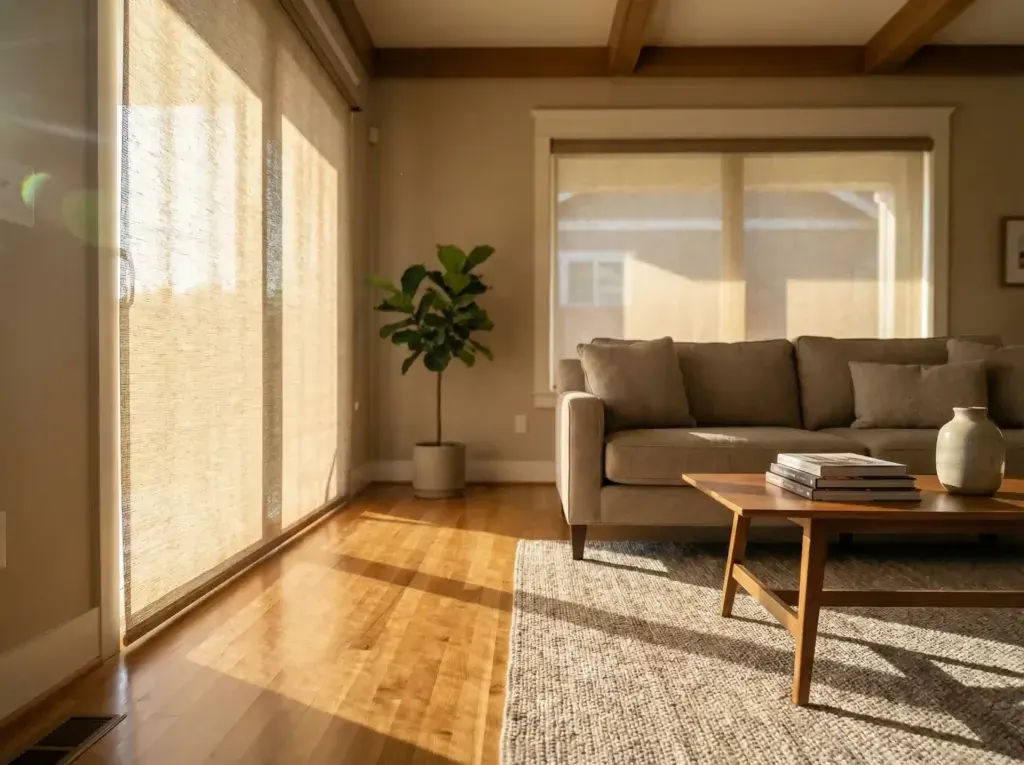
Cellular shades get talked about as an insulating upgrade more than any other window treatment, and the reason comes down to how the fabric itself is built.
Why Older Windows Feel Colder Than the Thermostat Says
Here's the thing people get wrong most often: they assume a cold room means a leaky window, order weatherstripping, seal every gap they can find, and the room's still cold. That's because a big part of what you're feeling isn't moving air at all. It's radiant heat loss, your body cooling toward a cold surface, plus a convective loop where air against that cold glass sinks and rolls across the floor. Both happen on a window with a perfectly good seal.
Older glass in a lot of Greenwood homes makes this more obvious, since the surface temperature of single-pane or early double-pane glass runs colder than current glass on a cold night. The thermostat has no way to measure any of this. It just reads air temperature at one spot in the room, which is why two people standing in the same room can disagree about whether it's actually cold.
Mount Style and Fit Change How Much Draft Gets Through
Fit isn't usually where people expect to spend money, but it affects how much value the shade actually delivers. Outside mount sometimes costs a little more in hardware and requires a slightly larger shade to cover the full opening with overlap, but it closes off more of the frame on an old or out-of-square window than an inside mount does for close to the same base price.
Side channels are an added-cost option on many cellular lines, worth budgeting for on the one or two worst rooms rather than skipping them everywhere to save money. A shade that fits loose gives up a meaningful share of whatever insulating value it was bought for in the first place.
What Window Treatments Can and Can't Fix
An R-value on a shade's spec sheet is real, but it's describing a few inches of fabric and trapped air, not the window assembly behind it. A single-pane window with a cellular shade in front of it is still a single-pane window; the shade reduces the chill a person feels sitting near it and helps the room hold warmth a little better, but it doesn't change the glass.
Where the frame has actually failed or weatherstripping has compressed flat, no fabric treatment closes that gap. That's worth a separate look, ideally before ordering shades for that specific window, since fixing an actual leak and adding a shade both matter and neither substitutes for the other.
Working out a per-room budget gets easier once real measurements and options are in front of you, and a free in-home measure is the point where estimates turn into actual numbers.
How Cellular Shades Trap Air Instead of Just Blocking Light
A cellular shade is built from pleated fabric folded into rows of hexagonal pockets, and it's those pockets, not the fabric itself, that do the insulating work. Air trapped inside a small enclosed cell doesn't move much, and still air is a poor conductor of heat, so the shade acts as a buffer zone between the room and the cold glass behind it.
Cell size varies by product line, usually somewhere between 3/8 inch and 1 inch, and shades come in single-cell or double-cell construction. Double-cell fabric has two rows of pockets stacked front to back instead of one, adding another layer of dead air. Manufacturers publish R-values for these products, and single-cell fabrics typically land around R-1.5 to R-2, with double-cell more like R-3 to R-3.5. That's the insulating value of the shade itself, added on top of whatever the window already provides.
None of that is a promise about a heating bill. It's a description of how the product is built and why it behaves differently than a roller shade or a flat fabric panel, neither of which has any air pocket at all.
Layering Shades and Drapery for the Coldest Rooms
Plenty of Greenwood homeowners already do a version of this without thinking about it: sheers for summer, heavier panels that come out for winter. Formalizing that into a real layered setup, a cellular shade underneath with lined drapery over it, does more for a genuinely cold room than either piece alone, especially in a room people actually sit in during the evening, like a living room with a big west-facing window or a primary bedroom.
The drapery needs to close all the way over the opening at night to do anything useful. A narrow panel that only covers the middle of the window and leaves both sides of the glass exposed looks nice folded open but isn't doing much when it matters most.
Frequently Asked Questions
Will cellular shades stop a window from feeling drafty?
They'll reduce the radiant chill and the convective draft that come off cold glass, which is most of what people notice sitting near a window in winter. They won't stop an actual air leak from a failed seal or worn weatherstripping. That's a separate repair, worth checking for before assuming shades alone will solve a cold room.
What's the difference between single-cell and double-cell shades?
Single-cell fabric has one row of air pockets and double-cell has two, stacked front to back. Double-cell insulates somewhat better, generally in the R-3 to R-3.5 range compared to R-1.5 to R-2 for single-cell, but costs more and stacks a little thicker at the top when raised. For a genuinely cold room it's usually worth the difference.
Does mount style really make that much difference?
It can. Inside-mounted shades leave a small gap between the fabric and the frame on both sides, right where cold air rolling off the glass gets past the shade. Outside mount overlaps the frame instead, which usually closes off more of that path, especially on an older or slightly out-of-square window.
 How to Measure Your Own Windows for Blinds or Shades
 Wood vs Faux Wood Blinds for Greenwood Homes: How to Pick
 Manual or Motorized: Choosing a Retractable Awning for Greenwood