Motorized Shades in Greenwood: What to Decide Before You Order
Everything about a motorized shade looks great on install day. The more interesting question is what it is like eleven months later, when a battery is fading and the summer schedule no longer fits the winter sun. This is the ownership side of it, written for a Greenwood homeowner who wants to know what the routine looks like before signing, rather than finding out during the first cold snap.
How the Motor Gets Its Power
Every motorized shade gets its power one of three ways, and the choice was made long before you started noticing it day to day. A battery wand clips into the headrail and gets pulled out for charging every so often. A hardwired shade runs off wire hidden in the wall, so there is never anything to charge. A plug-in shade sits between the two, drawing power from a nearby outlet through a visible cord.
Living with a battery shade means accepting a small recurring task into the household routine, the way a smoke detector needs a fresh battery eventually. Living with a hardwired shade means never thinking about power again, at the cost of having decided on it before the walls closed. Most Greenwood homes end up mixed: hardwired where it was practical during a remodel, battery everywhere it was added into a finished room.
None of that shows up as a problem on install day. It shows up months later, when one shade is noticeably slower than the rest. Knowing which power method sits behind which shade makes that moment less annoying.
Remotes, Hubs and Schedules
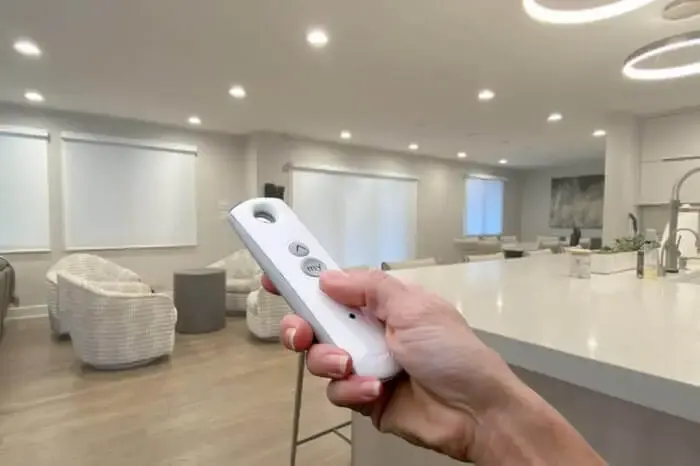
A direct remote costs nothing beyond the remote itself, worth stating before adding a hub to any quote. It pairs straight to the shade over radio, with no subscription and no ongoing software to maintain. What it does not buy is a schedule or a scene, and it will not answer to a voice platform such as Amazon Alexa or Apple Home.
A hub is the line item that adds cost and capability together. Budget for the bridge itself, and for a repeater if the Greenwood house is large or built with a lot of masonry, since signal struggles through stone and foil backed insulation. Zigbee and Z-Wave are the standards most likely under the hood, with Matter increasingly offered as a bridge between brands that would not otherwise talk to each other.
Google Home and Apple Home integration is worth asking about directly, since support depends on the specific hub and firmware rather than being a given. Scenes and schedules cost nothing extra once a hub is in place, so that part of the spend is really the hardware and the setup time on install day.
Which Windows Are Worth Motorizing
Go through the house room by room before ordering and separate the openings that are actually a hassle by hand from the ones merely nice to have automated. That list, more than any showroom display, should drive the budget.
- Anything above roughly eight feet, including transoms and stairwell windows.
- A shade over a tub or a bed, anywhere the cord means climbing up to reach it.
- A room with several shades that should move together as one.
- Large or heavy glass, where a cordless lift discourages daily use.
Cross the rest off on purpose rather than by default. A small bathroom window closed twice a year does not need a motor, and neither does a shade left down permanently for privacy. Pricing this room by room, at roughly $300 to $1,500 a window installed nationally, keeps the budget aimed at openings that will earn it.
Lead time runs two to five weeks once ordered, so build that into any renovation timeline.
Battery Life and the Charging Routine
Battery complaints follow a predictable pattern, and it rarely means the motor has failed. Hunter Douglas publishes roughly a year of battery life for its PowerView motors, and a shade running well short of that is usually explained by heavy daily use, a heavier blackout fabric, or a cold room draining the cells faster.
The failure looks specific if you know what to watch for. A shade slows down first, then starts refusing to finish a full run, stopping partway instead of reaching the bottom, then stops responding altogether. None of that is a broken motor. It is a battery asking to be charged, and charging takes hours rather than minutes.
The households that stop having battery problems are usually the ones that stopped waiting for a shade to die before doing anything about it. A fixed charging schedule, once a month or once a season depending on how many shades are in the house, prevents most of what looks like a malfunction from showing up at all.
Warranty, Service and What Ownership Is Really Like
Two warranties ride along with a motorized shade, rarely the same length. One covers the fabric and mechanism. The other covers the motor and electronics, usually shorter than the first. Ask for both in writing, and ask who comes out when a motor fails in year three, and whether labor is covered or only the part.
That is where buying from a company that measures and installs matters. A motor eventually stops running, and when the installer holds the account with the manufacturer, a claim goes through them and someone shows up. Buy the same shade online and the relationship is yours to manage, along with the shipping and the reinstall.
Day to day quirks are mostly minor: a brief motor hum while traveling, noticeable in a quiet bedroom at six in the morning. Two shades on one group can drift out of alignment after a year, which is a limit reset, not a defect. A Greenwood summer schedule is not a January one, so treat the system as a seasonal habit, swapping scenes and checking batteries when the clocks change.
Settle the power method and the control type before the order goes in, not after. Price hardwiring while a wall is open, and decide which windows are actually annoying enough to motorize before the fabric gets chosen. Greenwood Window Treatments puts all of it in writing for Greenwood homes, insured and bonded. Call (317) 854-7158 before you sign anything.
Frequently Asked Questions
How long do the batteries really last?
Hunter Douglas publishes roughly a year for its PowerView motors, and that is a fair planning number across the category. Actual results move with use. A shade running twice daily on a schedule drains faster than one you only touch on weekends, and a wide blackout roller works its motor harder than a small cellular shade does. Cold rooms cut battery capacity further on top of that. Rechargeable wands take hours to charge, not minutes, so plan around a dozen battery shades needing attention roughly once a month somewhere in the house.
Do I need a hub, or is a remote enough?
A remote is enough if pressing a button is all you want. It pairs directly to the shade over radio and needs no network at all, so it keeps working during an internet outage. A hub adds schedules and phone control, plus integration with other smart home devices, though it depends on your network and on an app someone else maintains. Start with whether you actually want the shades moving on a schedule. If not, skip the hub.
Can I add a motor to shades I already have?
Sometimes. Certain product lines are built so a motor can be retrofitted into the existing headrail or roller tube, and plenty of others are not. Even when it is possible, the labor plus the motor often comes close to the cost of a new motorized shade, so it is worth pricing both before deciding. If motorization is even a maybe, price it at the time of the original order. That is a lot cheaper than revisiting the question a year later.
 How to Measure Your Own Windows for Blinds or Shades
 Room by Room Comfort Through an Indiana Winter in Greenwood
 Wood vs Faux Wood Blinds for Greenwood Homes: How to Pick